Contents
- The White Wall Paradox: Framing the Unthinkable
- The Trap of Aestheticizing Trauma
- Confrontation vs. Comfort: The Accessibility Argument
- Anchoring the Image: The Necessity of Journalistic Context
- Redefining the Conflict Exhibition
The White Wall Paradox: Framing the Unthinkable
In practice, walking into a pristine gallery space dedicated to war photography presents an immediate, jarring dissonance. The white walls, climate-controlled air, and hushed acoustics belong entirely to the world of fine art. The subjects trapped within the frames belong to the mud, the blood, and the chaos of resource-driven unrest.
Curating war photography often risks sanitizing brutal realities to fit this sterile environment. True exhibitions must prioritize unvarnished truth over aesthetic comfort. The raw urgency of the field is polished away—replaced by a sterile contemplation that serves the institution rather than the subject.
Curatorial lead times spanning roughly 14 to 18 months often result in a gradual softening of the initial raw photo edit, as institutional pressures slowly prioritize aesthetic cohesion over journalistic impact. The initial selection of visceral, challenging images is gradually whittled down. Committees and stakeholders naturally gravitate toward photographs that are easier to look at. What remains often reflects the gallery's architectural sensibilities rather than the photographer's original documentary intent.
The Trap of Aestheticizing Trauma
Gallery lighting, framing, and spatial design possess the power to inadvertently turn human suffering into art objects. Standard gallery spot-lighting often sits somewhere around 50 to 200 lux, which can highlight the grain and tonal range of a silver gelatin print while obscuring the visceral reality of the subject matter. The viewer's eye is drawn to the mastery of the darkroom rather than the tragedy of the event.
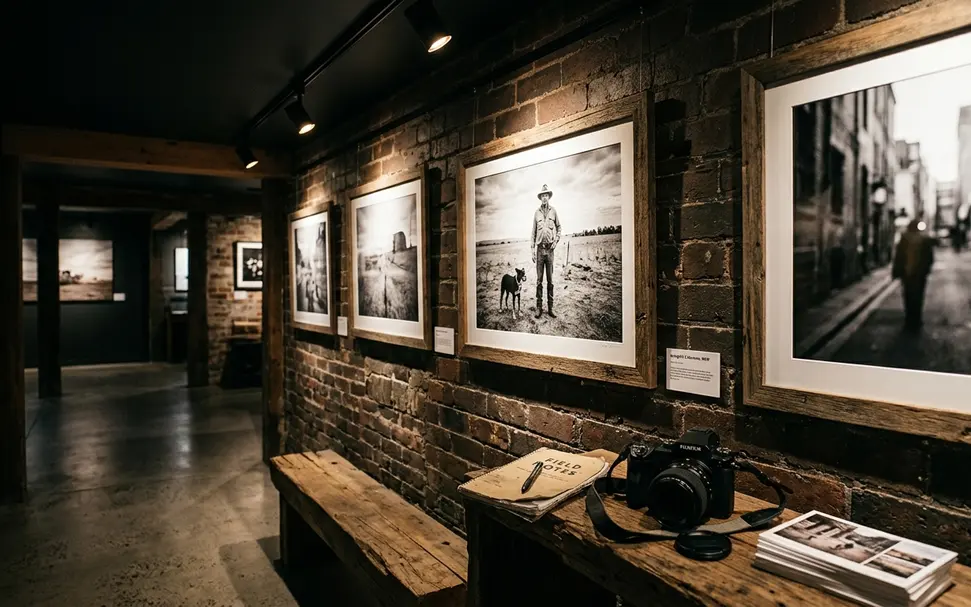
According to reports from the layout phase for a recent Asia-Pacific conflict retrospective, the curatorial team initially considered printing the images on certified high-gloss archival paper with dramatic spot-lighting to emphasize the contrast. They ultimately abandoned this approach. When a photograph of conflict is judged primarily on its composition or tonal range, the subject's dignity is compromised.
The ethical responsibility of the curator demands resisting the urge to make violence visually palatable. When human suffering is reduced to a purely aesthetic commodity, the gallery begins to function less like a historical archive and more like a trading floor. The visceral reality of a resource war is abstracted into tonal values and composition metrics, much like how complex geopolitical instability is sanitized into the daily fluctuations of the S& P 500 or the Dow Jones Industrial Average. The stakes of the image become as detached from human consequence as speculative binary options.
Confrontation vs. Comfort: The Accessibility Argument
Visitor observations suggest dwell times in front of highly graphic, unvarnished conflict images can be brief—often under a minute—compared with the several minutes often spent analyzing aesthetically softened, abstract representations of the same events. Curators often claim that softening the presentation makes the trauma accessible, preventing the public from looking away.
This stance fundamentally misunderstands the purpose of documentary photography. Discomfort is the necessary and correct response to war. Diluting the impact betrays the photographer's intent and the subject's reality. A photograph guaranteed to provoke discomfort forces a reckoning.
Challenging the viewer creates a more lasting engagement with the social issues depicted. The brief, intense encounter with a raw image leaves a permanent psychological mark, whereas a prolonged, comfortable viewing of an aestheticized image often results in passive consumption.
Risk Factor: Deliberately confronting audiences with unvarnished trauma can trigger severe secondary trauma responses, requiring galleries to implement clear, pre-entry content warnings and designate physical quiet spaces for decompression.
Anchoring the Image: The Necessity of Journalistic Context
An image stripped of its context in a gallery setting loses its journalistic integrity. Using minimalist, untitled gallery labels for photojournalism strips away geographical and political context and reduces specific human rights violations to generic studies of human suffering. Detailed captioning that names subjects, locations, and historical contexts is non-negotiable.
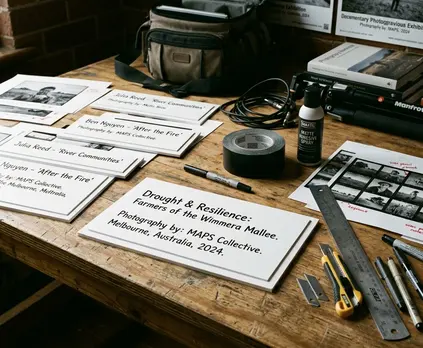
The editorial team established the captioning protocol by cross-referencing the photographer's original field notes with independent regional reporting. An ongoing partnership dating back to 2019 with local archivists allowed them to mandate a rigorous three-tier captioning system. During structured assessments, extended captions requiring 40 to 60 words of historical context demand a minimum placard size of 15 by 20 centimeters to remain legible at a standard viewing distance of 1.2 meters.
Text and image must work together to maintain the documentary nature of the work. While this rigorous captioning protocol can increase historical comprehension, its effectiveness relies heavily on the baseline literacy and language proficiency of the gallery demographic.
Recommendation: Implement a standardized captioning hierarchy that prioritizes the who, what, when, and where before any curatorial interpretation.
Redefining the Conflict Exhibition
Exhibitions of war photography must serve as historical records and calls to conscience, not mere aesthetic experiences. Transitioning a gallery space from a traditional fine-art display to a context-heavy documentary format typically requires roughly 3 to 5 weeks of pre-production research and independent fact-checking. This investment is the clearest way to ensure the exhibition honors the reality of the conflict.
The physical layout depends on context. The required level of ambient lighting and physical space between prints shifts dramatically depending on whether the exhibition features active, ongoing conflicts requiring urgent journalistic context versus historical retrospectives focused on archival preservation.
Curators and institutions must adopt a more raw, context-heavy approach to displaying photojournalism. The enduring power of documentary photography relies entirely on uncompromising honesty. Institutions must align their practices with established ethical frameworks governing conflict photojournalism to ensure the subjects are respected.
Critical Insight: The most effective exhibition design forces the viewer to confront the reality of the event rather than the technical skill of the photographer.