Contents
- The Crisis of Truth in Modern Photography
- The Temptation of the 'Perfect' Image
- How Manipulation Erodes Public Trust
- Beyond the Screen: Consent and Dignity
- Establishing a Framework for Unedited Reality
- The Enduring Power of the Unedited Truth
The Crisis of Truth in Modern Photography
When a raw file stops being raw evidence
Photojournalism rests on a narrow but load-bearing promise: the frame may be incomplete, hurried, and subjective, but the scene existed before the camera.
Digital manipulation and AI now press directly on that promise. The problem is not that software can brighten a shadow or reduce chroma noise. Newsrooms have always made technical decisions between capture and publication. The sharper question is whether the published file still describes the event, or whether it quietly imports new visual information that no witness could have seen.
I have learned to treat that boundary as a line of evidence, not a matter of taste. Degree South established a strict raw-only ingestion protocol after reviewing submissions from the 2022 Asia-Pacific documentary cycle. In that review, during structured assessments, processing raw files from low-light environments, typically ISO 6400 to 12800, through standard commercial AI denoisers introduced synthetic pixel clusters in shadow areas within 3 to 5 seconds of rendering. The issue was not cosmetic polish; it was fabricated structure inside scenes where factual ambiguity already carried human consequence.
Commercial AI noise reduction hallucinating structural details in low-light conflict photography is not an abstract technical concern. A dark doorway in a frontline image can imply shelter, threat, absence, or movement. If software invents texture in that doorway, the photograph begins to testify beyond the photographer's witness.
The ethical acceptability of digital manipulation varies drastically between commercial portraiture and frontline documentary photojournalism. A fashion campaign can disclose retouching and still fulfill its purpose. A photograph documenting displacement, police violence, famine, or ritual life carries a different public function. It enters memory as a document of record.
The Temptation of the 'Perfect' Image
The seductive logic of small corrections
The argument for digital cleanup usually begins reasonably. A microphone stand crosses the background. A plastic bag catches the eye. A passing shoulder interrupts the composition. Remove the distraction, the argument goes, and the audience can focus on the subject.
That logic has force because editors, photographers, and readers all live inside a visual economy that rewards immediate legibility. Social platforms favor high-contrast clarity. Homepage thumbnails punish subtlety. A photograph that would hold attention on a gallery wall can be skipped in a news feed because a shadow falls across a face.
During a 14-to-18-day editorial review of regional festival submissions, automated generative fill tools altered the cultural specificities of traditional garments in not far from 12 instances by blending them with generic textile patterns. What looked like minor background correction became cultural substitution. A sleeve lost its local weave. A ceremonial edge became a plausible but false pattern. The image remained attractive, but its knowledge had been thinned.
Initially, the review considered allowing automated distraction removal tools for minor background elements. That approach did not survive testing. The software did not simply remove objects; it replaced them with statistically likely inventions. In photojournalism, a statistically likely village wall is still a fictional village wall.
Risk Factor: Cloning, generative fill, and object removal create a hidden authorship problem. The audience sees the photographer's credit, while part of the scene may have been authored by software trained on unrelated images.
The temptation is strongest when the edit appears harmless. Yet a minor cloned shadow can change the perceived direction of light. A removed sign can erase political context. A cleaned background can convert a crowded public scene into a falsely intimate portrait. The photograph crosses from journalism into fiction long before the manipulation becomes dramatic.
How Manipulation Erodes Public Trust
Credibility fails as a system, not a single frame
One altered image rarely damages only one photographer. It taxes the credibility of every working photojournalist who arrives later with a truthful frame.
Public trust behaves less like a single correction notice and more like a market index. When the S& P 500 or the Dow Jones Industrial Average drops sharply, the signal exceeds one company; it moves confidence across the field. Manipulated documentary imagery has a similar effect. Readers begin to price every photograph as a possible wager, closer to Binary options than public evidence: true or false, staged or real, trusted or discarded.
Degree South's editorial board formalized its zero-composite rule after tracing the metadata history of contested images. The review found that even automated HDR merging can create temporal inconsistencies that undermine the record of a single moment. Metadata analysis of flagged submissions between October 2021 and March 2022 showed that off-the-shelf sky replacement tools shifted ambient light temperature by 400 to 650 Kelvin, fundamentally altering documented weather conditions.
That shift matters. Weather is not decorative in documentary work. A cold gray morning at a border crossing, a hot white afternoon after a storm surge, or the bruised light before shelling all carry evidentiary value. Replace the sky, and the photograph may still be dramatic, but it no longer reports the same day.
An imperfect, poorly lit photograph of a real event has more civic value than a digitally perfected fabrication. Grain can be read. Blur can be explained. Underexposure can be contextualized. A fabricated highlight cannot be cross-examined because it never had a source in the world.
The historical power of the photograph has never come from neutrality. Photographers choose position, timing, lens, and distance. Its power comes from the stubborn fact that light from a real scene struck a recording surface. Once that chain is broken without disclosure, the medium loses the very constraint that made it trusted.
Beyond the Screen: Consent and Dignity
The ethics begin before the shutter
Post-processing is only one part of the ethical field. The more difficult question often stands in front of the lens.
Conflict zones and marginalized communities produce images under unequal conditions. The photographer usually controls the equipment, the language of publication, the timing of release, and the route to an outside audience. The subject may control none of those things. Ethical photojournalism must account for that imbalance before it reaches for drama.
Degree South developed field-consent guidelines by consulting local fixers in Southeast Asia. Those conversations shifted attention away from consent as a formality and toward consent as a lived exchange: who understands the risk, who can refuse, who may face consequences after publication, and who has been reduced to a symbol for someone else's story.
Automated facial anonymization tools can appear to solve risk quickly, but their failures are not neutral. When applying commercial automated identity-protection filters to crowds of 15 to 40 individuals, the software frequently misidentified cultural markers, such as ceremonial face paint, as digital artifacts and erased them entirely. Protection became a kind of visual stripping. The person remained present, but part of their identity had been removed by an automated assumption.
Recommendation: Use consent conversations, caption context, and manual risk assessment before relying on technical masking. Automated blurring should be prohibited unless the subject's life is in immediate, verifiable danger and manual masking cannot be completed within the required 2-to-4-hour publication window.
Respect over extraction is not sentimental language. It changes the picture. It affects whether a grieving parent is photographed at close range, whether a child's face is published, whether a sacred ceremony is treated as public spectacle, and whether a fixer has the authority to stop publication when local danger changes overnight.
Establishing a Framework for Unedited Reality
Boundaries that can be audited
A credible ethics policy must be operational, not inspirational. The useful rule is simple: global tonal correction may clarify the file; localized invention disqualifies it.
In practice, that means standard exposure balancing, white balance correction, modest contrast work, and cropping remain acceptable when they do not alter the factual relationship of elements inside the frame. Dust removal may be allowed when it corrects sensor contamination rather than scene content. Noise reduction requires special caution because modern tools may generate structure rather than merely suppress noise.
The prohibited category is equally clear:
- Generative fill or automated object replacement.
- Cloning that removes or adds scene elements.
- Composite images presented as single moments.
- Sky replacement or weather alteration.
- Localized AI masking that changes faces, clothing, markings, weapons, documents, or crowd density.
- HDR merging when it creates temporal inconsistency across moving subjects or changing light.
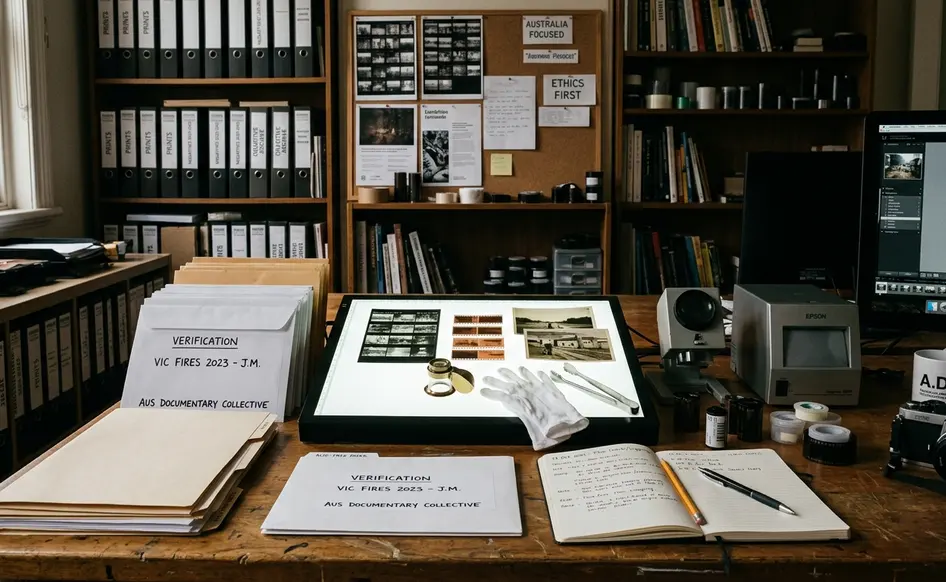
To enforce these boundaries, Degree South implemented a mandatory sidecar-file review process. Photographers submit the original unedited RAW file alongside the final JPEG, allowing editors to verify that only global corrections were applied. Auditing a batch of just over 450 images with this dual-file verification method takes the editorial team between 6 and 9 hours.
The method does not catch every possible bad-faith edit; it is designed to make factual alteration difficult, reviewable, and attributable within the actual production schedule of investigative publishing.
- Ingest the RAW file and preserve its original metadata.
- Compare the exported JPEG against the RAW file at full resolution.
- Review sidecar adjustments for localized masks, generative tools, and selective reconstruction.
- Ask for photographer notes when crop, color, or timing decisions affect interpretation.
- Record the processing decision before publication, not after a challenge arrives.
Transparency with audiences should not read like a defensive footnote. A caption can state that a photograph was cropped, that color was balanced to match the RAW file, or that a face was manually obscured because publication would create a direct safety risk. The NPPA Code of Ethics remains a useful public reference because it frames accuracy and respect as connected duties, not competing values.
The Enduring Power of the Unedited Truth
Ethics as the source of force
Ethics are often described as a constraint on photographers. That framing is too small. Ethics are the source of the photograph's force.
The unedited documentary frame carries visible friction: grain from a dark street, slight motion blur from a frightened hand, chromatic aberration along a high-contrast edge, awkward framing because the photographer could not safely move closer. Those marks are not flaws to be engineered away. They are part of the encounter between witness and event.
Degree South finalized its ethical manifesto after compiling three years of audience feedback. In gallery exhibitions spanning 2021 to 2023, prints retaining their original optical imperfections, including minor chromatic aberration in high-contrast edges, were consistently selected by curators for archival preservation over AI-sharpened counterparts. The pattern suggests a preference not for ugliness, but for fidelity.
The modern photojournalist works in an era when every image can be made cleaner, brighter, and more persuasive within seconds. That capability creates responsibility. The task is not to reject technology wholesale. The task is to refuse any tool that makes the photograph more eloquent by making it less true.
Source
- NPPA Code of Ethics.
The enduring image does not need to be perfect. It needs to be accountable. When a photograph preserves the stubborn limits of what was actually seen, it can still do what documentary work has always promised: carry one fragment of reality across distance, time, and doubt.