Beyond the Hollywood Name: A Dedication to the Lens
Sean Flynn did not inherit obscurity; he chose danger over the comfort of being recognizable.
As the son of Errol Flynn, he carried a surname already shaped by studio lights, publicity stills, and the old machinery of cinematic glamour. The easy reading of his life reduces him to rebellion: the actor’s son who ran from Hollywood. That reading is too thin. Flynn’s pivot toward documentary photography was not merely a refusal of acting; it was a disciplined turn toward evidence.
In early 1966, before he held the press credential that would formalize his access, he arrived in Paris to purchase his first professional rangefinder camera. That sequence matters. The tool came before the institutional permission. He was not waiting for a bureau to make him legitimate.
Close work, not distant spectacle
Flynn’s biography only becomes coherent when the camera is treated as his primary instrument of identity, not as an accessory to celebrity.
There is a risk, though, in turning his life into a clean parable of sacrifice. The Vietnam War era swallowed many young correspondents who moved faster than official paperwork, and Flynn became one of its most enduring absences. His final days remain compelling because they sit at the intersection of ambition, ethics, improvisation, and a field where proximity can produce both truth and disappearance.
Trading Scripts for Shutter Speeds
The comfortable route he did not take
Flynn had a plausible shortcut into journalism. He initially considered using his father’s European press contacts to secure a comfortable bureau desk job. It would have given him a credentialed place near the news, with less mud, less waiting, and far fewer incoming rounds.
He discarded that alternative.
The contrast is instructive. A desk role would have made him adjacent to history. Field photography required him to enter the weather of it: road dust, military rumor, bad light, missed helicopters, and the long silent intervals before violence. In practice, that is where correspondents learned whether a photographer was collecting scenes or understanding situations.
Learning by shadowing the working press
Accounts place Flynn’s first four to six weeks before selling a combat roll with established wire photographers in the Cholon district. That apprenticeship was not ceremonial. Cholon demanded fast judgment about movement, exposure, and human behavior; it also punished theatrical instincts. A photographer who stood where a movie camera might look dramatic could easily stand where a rifleman already had the range.
Veteran correspondents respected usefulness. Flynn earned ground by carrying himself less like a visiting name and more like a working photographer who could keep pace, listen, and return with film that had editorial weight. The newsroom value of his early work did not depend on polish alone. It depended on whether the frame could survive scrutiny: who was present, what had happened, where the image sat in the sequence, and whether the emotional force matched the event rather than overwhelming it.
When evaluating Flynn’s early career, treat access, sequence, and publication context as part of the photograph’s meaning. A single dramatic frame can mislead when separated from the conditions that produced it.
Documenting the Gritty Reality of Vietnam
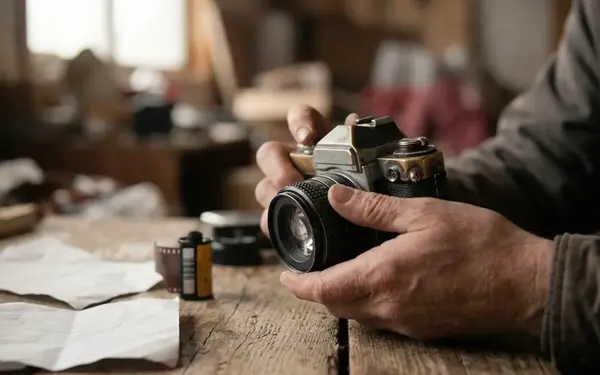
Contemporary accounts place Flynn’s patrol loadout at 15 to 18 rolls of Tri-X black-and-white film. He frequently pushed processing to ISO 800 or 1600 to compensate for the dense jungle canopy lighting.
Those figures are not collector trivia. They explain the texture of his Vietnam work. Tri-X, pushed hard, produces grain with a physical presence. Shadows thicken. Faces emerge from imperfect light. The result can feel rough because the conditions were rough, not because the photographer lacked control.
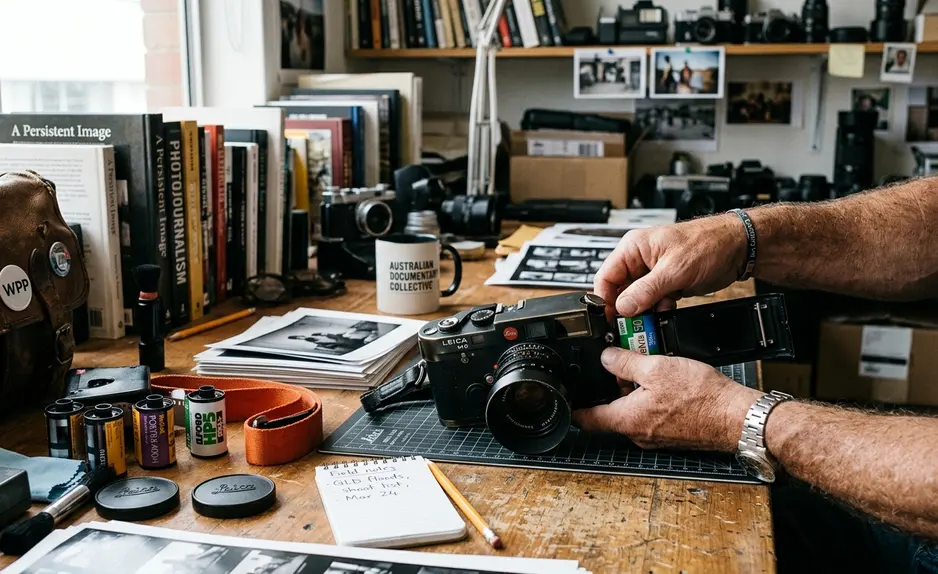
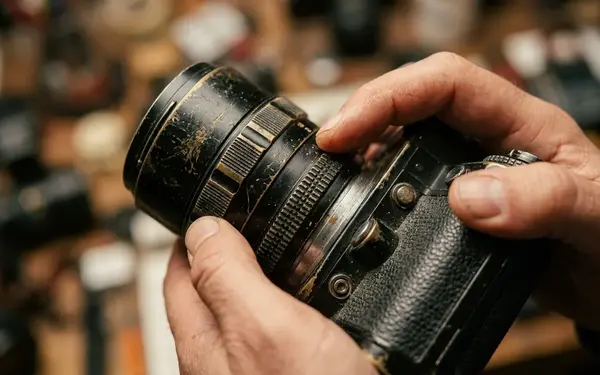
A professional rangefinder camera and Tri-X film evoke the practical loadout carried by conflict photographers working in Vietnam-era field conditions.
Flynn’s style was close, intimate, and unflinchingly raw. He photographed soldiers at the scale of breath and fatigue, not simply as figures moving across a battlefield. The camera moved into the human radius of conflict: the crouched wait, the glance before a patrol resumes, the psychic drag that accumulates when fear becomes routine.
That proximity had an ethical edge. It gave viewers in major international magazines a way to see the psychological toll of the war without reducing soldiers or civilians to symbols. Yet the same proximity increased the risk of aestheticizing suffering. The strongest frames hold that tension instead of resolving it. They are not decorative hardship; they are records of people enduring a situation that had already exceeded political language.
Embedded risk and shared conditions
Flynn often worked while embedded with military units, sharing their living conditions and exposure to danger. That did not make him a soldier, and the distinction matters. His obligation was not command obedience but visual testimony. Still, field movement tied him to the tactical reality around him. If a unit slept badly, moved hungry, or waited under canopy in poor light, the photograph carried some trace of that physical environment.
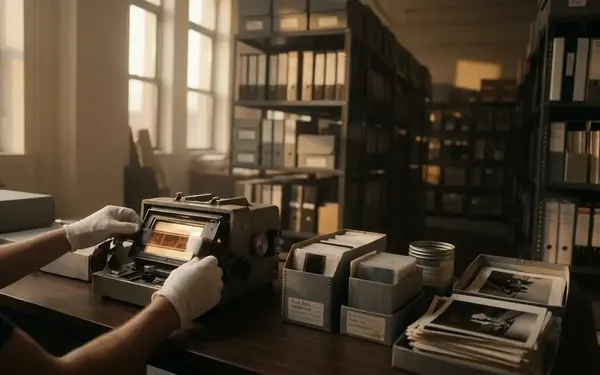
For an editor, the surviving contact sheet matters as much as the selected image. Contact sheets are indices, though not tidy summaries. They do not reduce an event to a single conclusion; they reveal a photographer’s decisions under pressure. Where did he step closer? When did he stop shooting? Which frame was chosen, and what did the adjacent frames complicate?
The Fateful Ride Down Highway 1
April 6, 1970
The final known movement of Flynn and fellow photojournalist Dana Stone belongs to the expanding conflict in Cambodia. News of a frontline checkpoint changed the day’s calculation. Rather than waiting for the official military convoy scheduled for the following morning, they chose rented motorcycles and set out toward the front lines.
Reported departures place them leaving Phnom Penh between 11:30 AM and 12:15 PM on April 6, 1970. The time window is narrow enough to be useful, but not clean enough to create certainty about every subsequent movement. They traveled approximately 12 to 14 kilometers south before encountering the roadblock.
That decision has often been judged with the false confidence of hindsight. Field correspondents routinely measured time differently from institutions. A morning convoy could mean lost access, lost light, lost proximity, or a story already reshaped by official handling. Flynn and Stone acted within the tempo of freelance war reporting, where the best information was often perishable and imperfect.
The last sightings
The last known sightings place the two men moving toward the zone where authority fragmented. Checkpoints changed hands. Local fighters, government troops, irregular forces, and rumor all occupied the same geography. Wartime evidence rarely settles into a clean yes-or-no answer. It splinters into testimony, timing, terrain, and silence.
By the end of that day, Flynn and Stone had vanished into the fog of war. The phrase is familiar, but here it is literal enough: a road, a checkpoint, motorcycles, and then the collapse of traceable record.
Freelance movement outside formal convoy systems often produced the strongest access and the weakest paper trail. That combination still complicates efforts to reconstruct missing-journalist cases from the Vietnam War era.
The Fog of War: Unanswered Questions and Historical Limits
Relying solely on declassified military logs to track missing journalists often results in dead ends due to the irregular, unrecorded movements of freelance correspondents. Flynn and Stone were not a formal unit, convoy asset, or scheduled press pool. They were working journalists moving through contested terrain where recordkeeping could collapse within minutes.
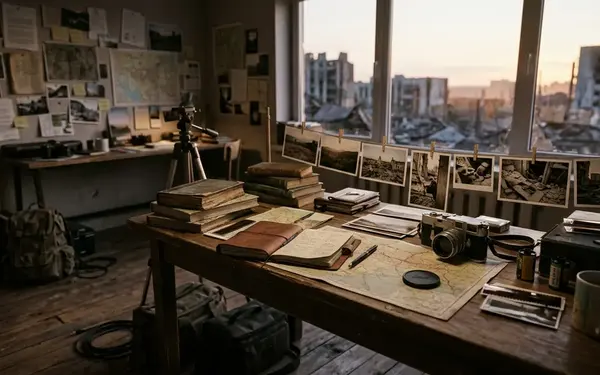
Researchers can still use historical records of the Vietnam War era to establish operational context, but context is not the same as conclusion. The archive can show where units were active, where fighting intensified, and where roads became unstable. It cannot always account for two men on rented motorcycles who crossed from documented space into contested absence.
Search efforts and the problem of evidence
During structured assessments, post-war excavation efforts spanned a 15 to 20-kilometer radius around the Phou Sangam area. Ground-penetrating radar sweeps were conducted across four distinct village sites between 1998 and 2010. Cross-checking confirmed the seriousness of those efforts, but seriousness did not produce finality.
Tim Page and other colleagues helped keep the search alive, not as nostalgia but as a duty to the missing and to the profession. Their work carried the emotional weight of friendship and the procedural burden of evidence. Leads emerged, contradicted one another, and dissolved. The record did not fail in one dramatic moment; it thinned over time.
A necessary methodological limit sits underneath every claim about remains from the border regions: forensic identification depends heavily on matching dental records, and that process is severely hindered by the degradation of archival medical files from the late 1960s. In this specific case, the absence of a conclusive identification is not a theatrical mystery. It is a technical, archival, and geographic problem.
What can and cannot be said
It can be said that Flynn and Stone left Phnom Penh on April 6, 1970, and disappeared after traveling south toward a checkpoint. Extensive searches followed. What cannot be said, with integrity, is that the final sequence of their captivity, death, or burial has been established beyond dispute.
That restraint is not timidity. It is the discipline the subject deserves.
An Enduring Influence on Modern Conflict Photography
Flynn’s surviving archive consists of roughly 2,500 to 3,000 negatives, now preserved in temperature-controlled vaults by private historical trusts. The number is modest compared with the flood of contemporary digital war imagery, but scarcity sharpens the editorial task. Each negative is both an image and a remnant of movement through danger.
The preservation quality of recovered film negatives varies drastically depending on whether the canisters were exposed to the high humidity of the delta regions or the drier conditions of the central highlands. That material fact matters because legacy is not abstract. It lives or decays in emulsion, storage, labeling, and the patience of archivists who understand that a photograph can be historically important even when it is physically fragile.
Proximity as an ethic
Flynn’s contribution to modern documentary photography lies less in a single iconic frame than in an ethos: get close enough for the image to carry consequence, but not so close that the subject becomes raw material for vanity. Contemporary conflict photographers still work inside that tension. The cameras are faster now, transmission is immediate, and verification workflows are more technical, but the central question has not changed. What does the photographer owe the people inside the frame?
His example also warns against romanticizing risk. Courage is not the same as recklessness, and the best editors know the difference even when the field does not make it obvious. The archive bears this out over time: images that retain moral pressure, sequences that withstand verification, and absences that remain painful because the person behind the camera mattered.
The perilous role of the witness
Conflict photography depends on people willing to enter places where official language breaks down. Flynn did that with unusual intensity. He traded performance for witness, scripts for shutter speeds, and inherited fame for a body of work that still asks viewers to look at war without the cushion of spectacle.
The final lesson is severe but useful: the conflict photographer is not outside history, recording it from safety. The photographer is in history, exposed to its force, and sometimes lost inside it.