Papua New Guinea punishes the photographer who tries to disappear. The camera hidden under a jacket, the long lens fired from the treeline, the frame stolen while a man's back is turned — these tactics, still taught as virtues in some corners of photojournalism, collapse within hours of arriving in a Melanesian village. What replaces them is slower, louder, and far more revealing: a presence that is announced, negotiated, and continuously renegotiated for as long as the work lasts.
Contents
- The Fly on the Wall Dies in the Highlands
- Who Actually Owns the Ground Underfoot
- Four Hundred Phrases and a Long Afternoon
- Consent That Cannot Be Signed
- Rice, Kina, and the Line Nobody Should Cross
- Fifteen Minutes in Highland Humidity
The Fly on the Wall Dies in the Highlands
The invisible observer is a fiction anywhere, but in Papua New Guinea it is a self-defeating one. Village social life is built on the visibility of obligation: who arrived, who was fed, who spoke to whom, who owes what. A stranger who moves through that architecture attempting to leave no trace reads not as neutral but as evasive, and evasiveness in a place where land disputes and sorcery accusations turn on questions of intent is a dangerous thing to project.
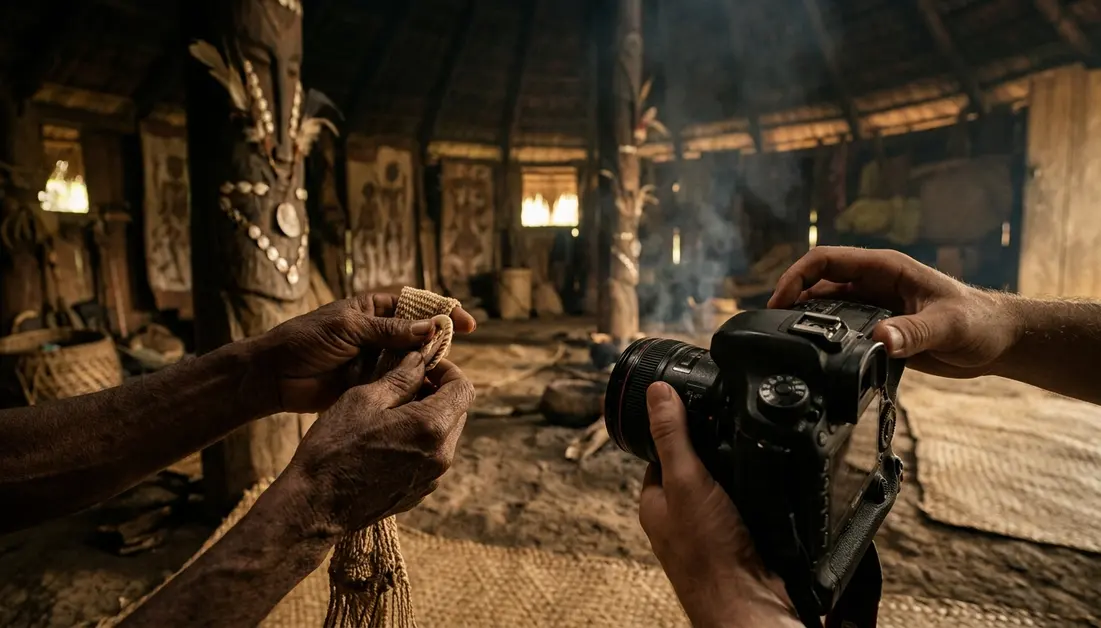
Working methodology inverts the standard approach. The first 48 to 72 hours of village integration are spent with no visible camera equipment at all. Bags stay closed. Bodies stay in the vehicle or under a bed in the haus kiap. The photographer sits, eats, walks the gardens, gets the names of the pigs wrong, and absorbs the shape of the day before the shape of the frame.
The paradox is that this visible, participatory presence produces more unvarnished material than covert observation ever did. People who have agreed to be documented stop performing for the lens within a day or two. People who suspect they are being photographed without agreement perform defensively for weeks, or simply leave the frame.
There is a real cost. Negotiated presence means the photographer forfeits certain images permanently — moments of grief, of conflict, of ritual that the community declines to open. Some of those refusals are the most important information the assignment produces.
Who Actually Owns the Ground Underfoot
The original plan for one Highlands project involved a week in Port Moresby collecting provincial government permits, stamped letters, the usual paper armour. Local fixers dismantled that plan in a single conversation. The vast majority of land in Papua New Guinea sits under customary tenure, held by clans and lineages rather than the state, and a provincial letterhead carries no authority across a boundary the province does not control. Regional paperwork is largely decorative at the village level; the operative permission is granted face to face or not at all.
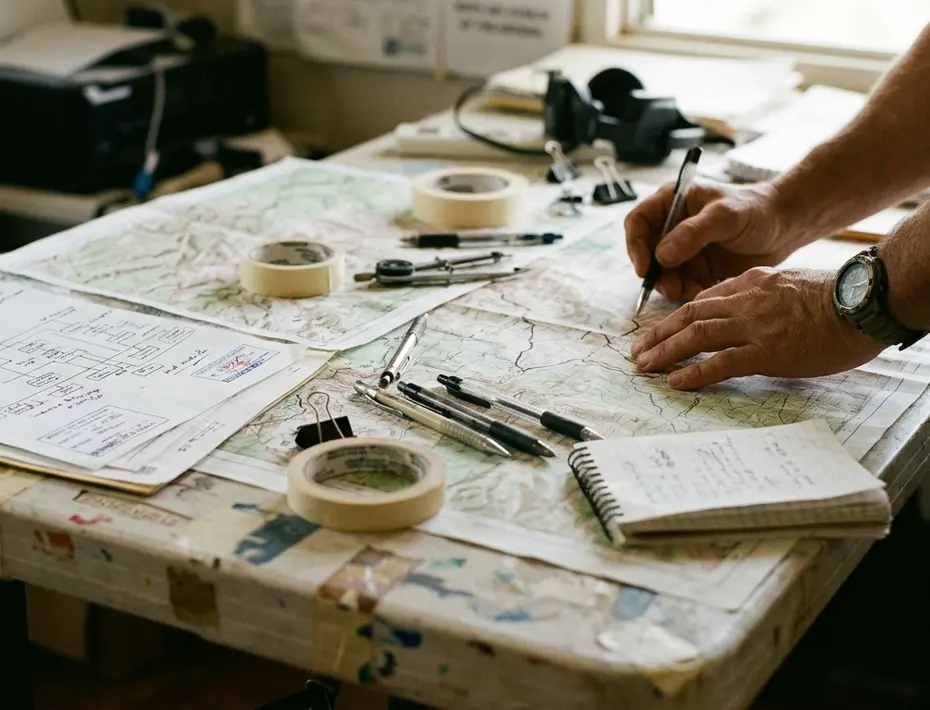
So the protocol reversed. On arrival, before gear is unpacked, the work is to find the local councilor or the village magistrate and introduce yourself properly. That conversation establishes three things: who you are, what the project actually covers, and what it explicitly will not cover.
Negotiation periods commonly run three to five days before a camera comes out of the bag. Elders ask hard, practical questions. Where do the pictures go. Who profits. Will the images be used in a land claim. Will they appear in a way that shames the clan in front of a neighbouring one. These are not obstacles to the work; they are the terms of it.
Right of way does not exist in the sense a Western photographer assumes. A track through a coffee garden belongs to someone. A river crossing belongs to someone. Walking it without acknowledgement is a trespass with consequences that will land on your hosts long after the photographer has flown out of Mount Hagen.
Four Hundred Phrases and a Long Afternoon
Three hundred to four hundred core Tok Pisin phrases will open more doors than any accreditation card ever issued. Not fluency — functional, respectful, badly accented competence. Enough to greet, to explain, to apologise, to ask permission and understand the answer, to follow the thread of a joke at your own expense.
Linguistic effort is legible proof that time was invested before arrival, and in a gift-and-obligation economy, invested time is currency. The interpreter-dependent photographer is always at one remove, and everyone in the circle knows it.
Then there is stori. Sharing stories is not small talk preceding the real business; it is the business. Sessions of two to four hours before any documentation begins are ordinary, sometimes daily. Genealogies get recited. Old disputes get relitigated. Someone explains why a particular ridge cannot be photographed. The photographer who treats these hours as delay will spend the whole assignment outside the circle of trust, shooting surfaces.
Practitioner accounts from the Southern Highlands describe the same pattern: the images that matter arrive after the third or fourth long conversation, never the first. The sequence is the method, and Melanesian ethnographic fieldwork describes as much.
Bilas or Work Clothes
Ask, during stori and not at the moment of the exposure, whether people want to be documented in ceremonial bilas or in daily attire. Assuming the feathers are more authentic than the football shirt is the single most common failure of judgement in Highlands coverage.
Village Entry and Documentation Protocol
- Leave camera gear secured and out of sight upon initial village entry.
- Locate and introduce yourself to the village magistrate or local councilor before anything else.
- Conduct initial stori sessions in Tok Pisin, explaining the project scope, the intended outlets, and the documentation limits.
- Allow three to five days of negotiation before unpacking bodies and lenses.
- Repeat the consent conversation across separate community meetings, not once in a single gathering.
- Agree explicitly on ceremonial dress versus everyday clothing for every portrait situation.
- Arrange a contribution to the communal kitchen rather than individual cash payments.
- Return physical prints to the people photographed before leaving the area.
Consent That Cannot Be Signed
Set the standard Western model release beside a functioning communal consent process and the release looks like what it is: a document designed to protect a publisher from litigation in a jurisdiction that has nothing to do with the village. It assumes a uniform literacy level. It assumes an individual owns their own image. It assumes the signatory grasps the reach of a magazine, a gallery wall, an image search result. Across much of rural Papua New Guinea, at least two of those assumptions fail.
The working alternative is verbal and communal, and it is deliberately repetitive. Consent protocols repeated across three distinct community meetings give people time to reconsider, to consult absent relatives, to withdraw. Each round covers the same ground in plain Tok Pisin: the pictures may appear in magazines, they may hang in galleries overseas, they will exist on the internet where anyone can see them and they cannot be recalled.
Presentation belongs to the subject. That means distinguishing between bilas worn for specific ceremonies lasting one to two days and the clothing people wear to dig gardens or sell buai at the roadside. Collapsing the two flatters an exotic expectation and misrepresents a life. Failure to make that distinction during consent negotiations is where most ethical damage actually occurs, long before publication.
These frameworks have a hard boundary, and it should be stated rather than buried. Communal verbal consent extends only to editorial and gallery contexts; commercial advertising and syndication still require legally mandatory Western releases, and no amount of careful village protocol substitutes for them. The broader principles here align with United Nations guidelines on indigenous representation, though the instrument is a declaration of principle rather than an enforceable field procedure.
Where Consent Stops
A verbal community agreement documented in a field notebook will not protect a subject, or a photographer, when an image crosses into advertising use. Keep commercial licensing entirely out of any project built on communal consent.
Rice, Kina, and the Line Nobody Should Cross
Reciprocity is not optional in Melanesia. The visitor who takes and gives nothing has broken something more fundamental than etiquette. But the obvious solution, cash for pictures, corrodes the documentation itself: pay a man to stand in his bilas and the resulting frame records a transaction, not a life.
The distinction that holds up in practice is between purchasing a photograph and contributing fairly to a community that is hosting you. Contributions of 20 to 25 kilograms of rice or root vegetables to the communal kitchen feed everyone, including people who were never photographed, and enter the village economy through the same channels any guest's gift would. Direct cash payments that exceed standard local daily labor rates of 35 to 45 Kina distort those channels, creating competition over access to the photographer and resentment toward whoever secured it.
Other forms of exchange carry weight without the distortion:
- Buying and sharing food at the communal fire rather than eating separately from supplies brought in.
- Covering fuel, carriers, or vehicle hire at going rates, paid to the people who actually did the work.
- Delivering printed photographs directly into the hands of the people in them.
- Contributing to a stated community need — a school roof, a water tank, where the councilor, not the photographer, nominates the priority.
Payment records should be as transparent to the community as to the commissioning editor. Ambiguity about money is what turns a returning photographer into an unwelcome one.
What the Print Settles
A returned photograph closes the loop that a fee cannot. It converts the exchange from extraction into something the community holds a piece of.
Fifteen Minutes in Highland Humidity
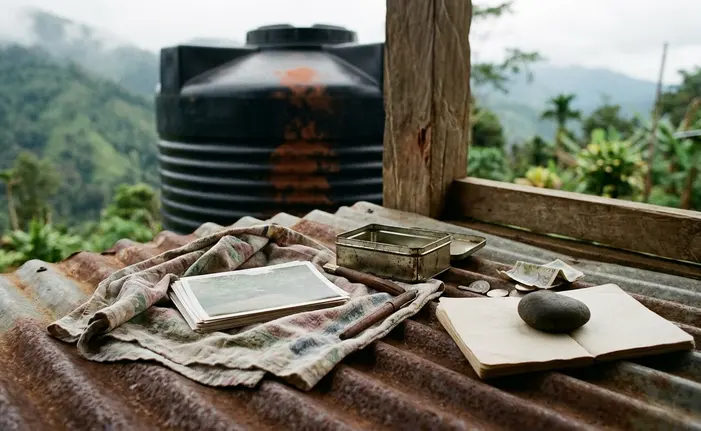
Outside Mount Hagen, late afternoon, the light going the colour of weak tea. A Huli wigman has just finished sitting for a portrait series: the woven wig, the yellow ambua clay across his cheekbones, the everlasting daisies stitched along the crown. Twenty minutes of quiet work, the negotiation for it done days earlier in a haus with six men and a great deal of stori.
The instant film comes out of the back of the camera and goes straight into a shirt pocket, face inward, because the highland humidity makes the chemistry sluggish and the image needs ten to fifteen minutes in the warm dark before it resolves. The wigman waits. A boy of about nine drifts over, then four more. Nobody speaks much.
When the print is pulled out, the wigman takes it by the white border with both hands, the way a document is handled. He turns it toward the last of the light. He does not look at himself first; he looks at the row of daisies, checking the wig, then at his own eyes, then he laughs once and passes it sideways to the man beside him. It travels the whole group and comes back. Fifteen to twenty prints go out over the course of that session, and by dusk they are being shown in the doorways of three different houses.
He keeps his. It goes into a tin, with a school certificate and a photograph of a brother who died. That is where the negotiation finally lands: not in a notebook, not in a release form, but in a tin in a haus above the Wahgi valley, held by the man who decided what the world would be allowed to see of him.