What Unsecured Field Cards Cost Local Sources
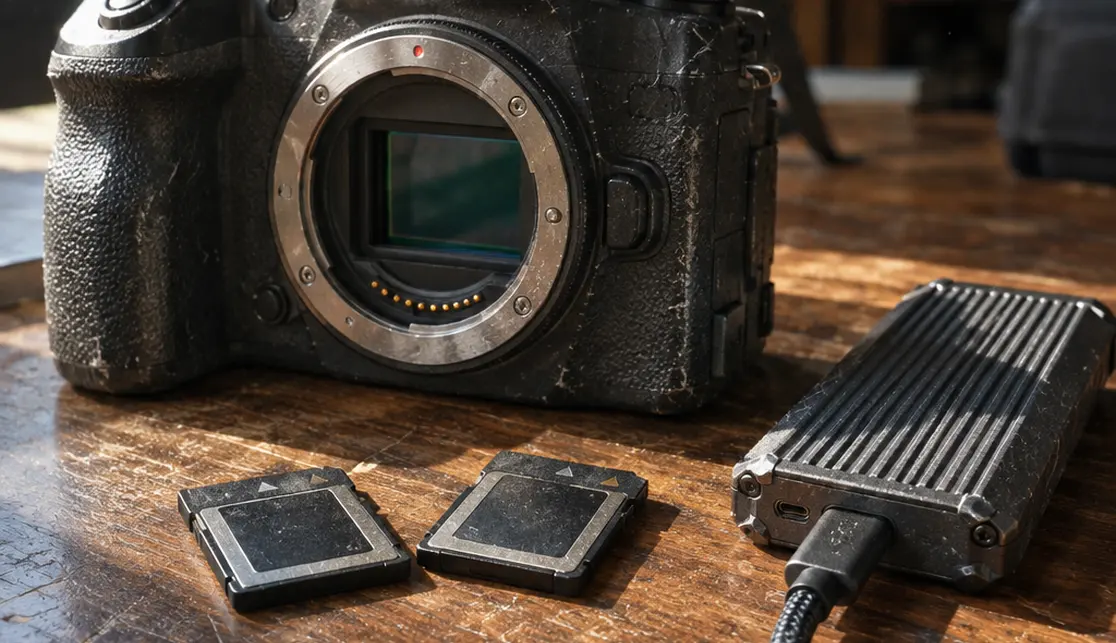
An unencrypted CFexpress or SD card seized at a military checkpoint exposes local fixers, witnesses, and civilian subjects to immediate retaliation. Wiping that card under duress, on the other hand, destroys vital historical documentation of resource-driven unrest. Field teams across the Asia-Pacific established a strict zero-trust media baseline after analyzing equipment seizures during regional civil unrest between 2021 and 2023, where standard in-camera "Quick Format" commands left full FAT32 and exFAT file tables intact for border forensics teams to reconstruct.
Mobile forensic extraction units deployed at military checkpoints can clone an unencrypted 64GB UHS-II SD card and rebuild deleted directory structures in 4 to 7 minutes. During an infrastructure blackout, photographers face a dual threat: physical confiscation of hardware by hostile actors and electronic interception over compromised local networks. When state telecom providers shut down 4G and fiber backbones, rogue base stations often remain active to harvest IMSI identifiers and intercept unencrypted FTP handshakes within a 1.5-kilometer to 3-kilometer radius.
In high-risk zones, handling unencrypted media presents binary options: total cryptographic isolation or complete source compromise. Every storage medium must be treated as already compromised the moment it leaves the camera body.
Configuring Air-Gapped Disk Encryption Before Deployment
Cryptographic keys and disk encryption software must be installed, tested, and verified on an air-gapped field laptop before entering a contested zone without internet access. Provisioning an air-gapped field laptop requires compiling dependencies and entropy-testing VeraCrypt hidden containers over a 36-to-48-hour burn-in period prior to departure. When designing off-grid storage architecture, collective members initially tested hardware-encrypted keypad SSDs, but abandoned them after military customs officers immediately recognized the physical PIN pads as high-value intelligence targets; the protocol shifted to software-based hidden volumes inside generic, unbranded aluminum NVMe enclosures.
To configure a plausible deniability storage array and execute a clean transfer workflow, follow this sequence:
- Partition a 1TB external NVMe drive using VeraCrypt or LUKS with an outer decoy volume and an inner hidden container.
- Populate the outer decoy volume with 25GB to 40GB of plausible, non-sensitive cultural B-roll to withstand cursory timeline inspection if forced to surrender a password under duress.
- Shoot raw files to primary media in a dual-card camera body, then transfer the take immediately to the mounted hidden container on the external SSD.
- Wipe the camera card via the laptop terminal rather than the camera menu. Executing a full zero-fill overwrite on a 128GB CFexpress Type B card via a field laptop terminal takes 11 to 16 minutes depending on thermal throttling, whereas a standard in-camera format takes less than 3 seconds and clears zero underlying sectors.
Hidden volume plausibility breaks down if the host operating system logs mount histories, shell history files, or recent document paths to an unencrypted system swap partition, so disable system swap and shell logging during the pre-deployment build.
Purging EXIF Coordinates, Serial Numbers, and Voice Memos
Scrubbing top-level EXIF directories while leaving proprietary MakerNotes intact exposes the camera body's internal serial number and exact shutter actuation count inside nested JPEG preview layers. Photo editors refined the metadata sanitization pipeline after discovering that standard desktop export presets stripped basic tags while leaving internal lens serial numbers, GPS coordinates, and precise timestamps embedded inside proprietary raw headers.
Unstripped proprietary raw formats (CR3, NEF, ARW) retain embedded full-resolution JPEG previews and sidecar WAV voice memos that add 2MB to 6MB of overhead per frame and preserve exact UTC satellite timestamps. Before archiving or transmitting, run an offline batch script via ExifTool metadata specification documentation parameters to purge identifying tracks while preserving essential photo desk strings:
exiftool -all= -tagsfromfile @ -caption-abstract -copyright -overwrite_original /path/to/sanitized_selects/On a low-power field ultrabook, this offline ExifTool batch script typically strips 60 to 120 raw frames in 18 to 35 seconds. Delete any sidecar XMP files and attached WAV annotations prior to running the command.
Filesystem Timestamp Sanitization
Filesystem touch commands must be executed post-sanitization to reset
FileModifyDateandFileCreateDateattributes to a generic 24-hour window, preventing timeline correlation with checkpoint transit logs.
Redundant Satellite Upload Workflows Under Total Blackout
Legacy L-band portable satellite terminals deliver sustained uplink speeds of 128 kbps to 384 kbps, requiring raw 45-megapixel frames to be downsampled to lossy DNGs or 2500-pixel long-edge JPEGs weighing 450KB to 800KB each. Transmitting over BGAN, Iridium, or portable satellite terminals during a state-imposed communications blackout forces a constant trade-off between image fidelity and radio-frequency exposure. Field engineers compared raw-to-DNG compression ratios against older satellite terminal upload speeds, settling on split-archive SSH transfers that survive abrupt power teardowns without corrupting the entire dispatch.
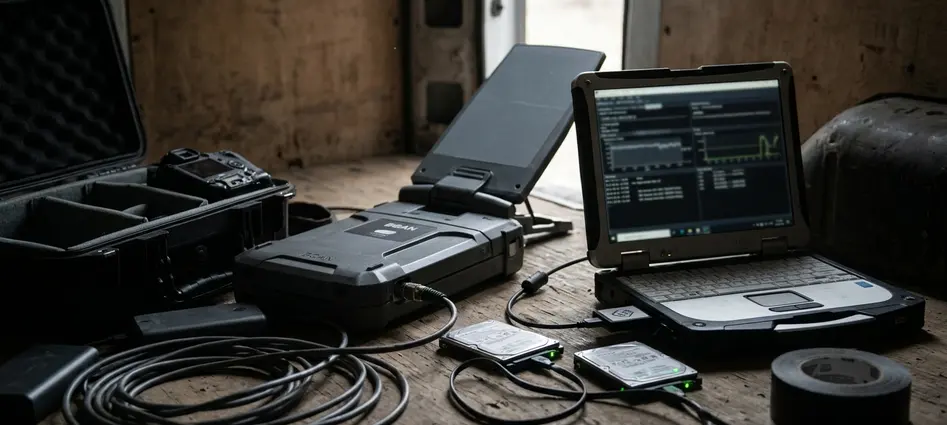
To push dispatches over narrowband links without drawing direction-finding sweeps, adhere to strict transmission discipline:
- Stage Offline: Convert sanitized raw selects into compressed DNGs or high-priority JPEGs and pack them into an encrypted tar archive completely offline—never power on the terminal while preparing files.
- Chunk the Archive: Segment the encrypted tar archives into 1.5MB to 2MB chunks and push them via
rsync --partial --bwlimitover SSH, allowing an interrupted upload to resume within 8 to 12 seconds of re-establishing a carrier lock. - Transmit in Bursts: Establish a line-of-sight connection from a concealed position. Active satellite transmission windows are strictly capped at 6 to 9 minutes per firing position before mandatory teardown and a minimum 800-meter physical relocation to evade direction-finding sweeps.
Executing a Pre-Transfer Purge at an Unexpected Checkpoint
Approaching an unannounced rural roadblock at night with 25 to 35 minutes of untransferred raw imagery sitting in dual card slots typically provides only 20 to 45 seconds of visual lead time. In this window, a photographer must choose between initiating an electronic overwrite or executing a physical media swap.
Relying on the camera's internal menu is fatal to source security. Initiating an in-camera low-level format on a 128GB SD card requires 45 to 90 seconds of uninterrupted battery power. Popping the card door mid-cycle halts the storage controller before the NAND flash translation layer completes its purge, leaving raw image blocks intact beyond the truncated sector.
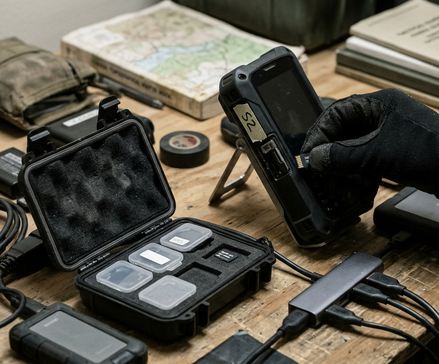
Physical separation outperforms electronic wiping under severe time constraints. The rapid-swap decoy drill was developed by timing photographers seated inside cramped transport vehicles as they attempted to purge dual-slot camera bodies. Routing primary capture to a microSD card seated inside a mechanical SD adapter allows a photographer to palm the 11-millimeter by 15-millimeter wafer into a seam or boot lining and seat a pre-staged decoy card in 4 to 6 seconds.
When an armed patrol demands your primary camera body before you have cycled cards to your encrypted drive, does your current field rig allow you to swap in a pre-staged decoy card in under five seconds, or will you be forced to hand over your source's face?