Five Years of Negatives and the Commercial Publishing Dead End
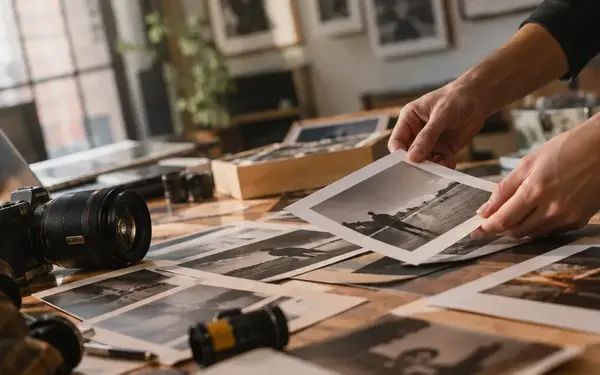
Late-night review sessions in a cramped second-floor Collingwood studio set the physical baseline for the monograph. Across long trestle tables, the collective spread 1,400 5x7-inch silver-gelatin and inkjet archival work prints to evaluate five years of documentary reportage across the Asia-Pacific. Over a rigorous 14-week editing window between 2021 and 2022, that initial mountain of paper was systematically distilled into a cohesive visual ledger of regional resource scarcity and civil unrest.
Taking that dummy manuscript to traditional publishing houses exposed an immediate structural impasse. Three separate commercial trade imprints reviewed the sequence and issued identical demands: excise the extended historical essays and cut the photographic plate count in half to hit a standardized retail price point. To justify the substantial press setup costs of mixed tritone and four-color lithography signatures, those commercial publishers required an 8,000-copy minimum retail run.
Accepting those terms meant gutting the journalistic spine of the project. Stripping away the archival context and field notes would have reduced complex geopolitical testimony into disconnected aesthetic fragments. The photographers voted unanimously to reject the trade contracts, assume full financial liability, and cap an independent print run at 750 copies. Retaining complete editorial authority over sequencing, caption length, and paper stock ensured the historical record remained intact.
Pre-Selling the Print Run Before the Presses Rolled
Securing $42,000 AUD in hard production capital within a strict 32-day pre-order window dictated every operational decision before locking in the paper mill order. Rather than treating crowdfunding as an open-ended charity drive or a speculative gamble, the collective approached the campaign as an exacting pre-order ledger. Exact lithography, binding, paper, and sea-freight quotes were locked in first; the funding tiers were engineered backward from those hard invoices.
Because the standard clothbound book carried a steep $68 AUD per-unit manufacturing cost at a 750-copy volume, standard retail markups alone could not cash-flow the press deposit. The financial architecture relied on collector-grade subsidies built directly into the campaign structure:
- Archival Print Subsidies: Sixty 8x10-inch selenium-toned silver-gelatin prints were struck from the original negatives and priced at $380 AUD each, generating high-margin revenue that directly offset the base lithography setup.
- Bespoke Collector Editions: Twenty-five handmade clamshell box editions featuring signed multi-photographer suites were offered to established private collectors and institutional buyers.
- Targeted Pre-Launch Outreach: Direct briefings with regional historians, Asia-Pacific archival specialists, and gallery curators secured 40% of the total capital baseline before the campaign link was ever released to the general public.
Capital Ledger Realities
Direct-to-collector pre-selling successfully covered the hard lithography and binding invoices without outside equity, but it exacted a massive operational toll: the collective absorbed 450 to 500 hours of uncompensated administrative, accounting, and customer service labor across four months. While this direct-subsidy model proved effective for a multi-photographer collective with established archival print collectors, solo practitioners lacking an existing print-buying patronage cannot assume identical pre-sale velocity.
Translating Field Journalism into Paper, Ink, and Thread
Weaving four distinct photographic voices into a single monograph requires a fundamentally different structural logic than editing a solo monograph. A single-photographer book can rely on a consistent visual signature to carry the viewer across quiet transitions. When merging multiple photojournalists documenting resource conflict across different island archipelagos, ego and individual style frequently collide. To prevent the publication from reading like a disjointed anthology, the collective brought in an external book designer to operate as an impartial sequence editor.
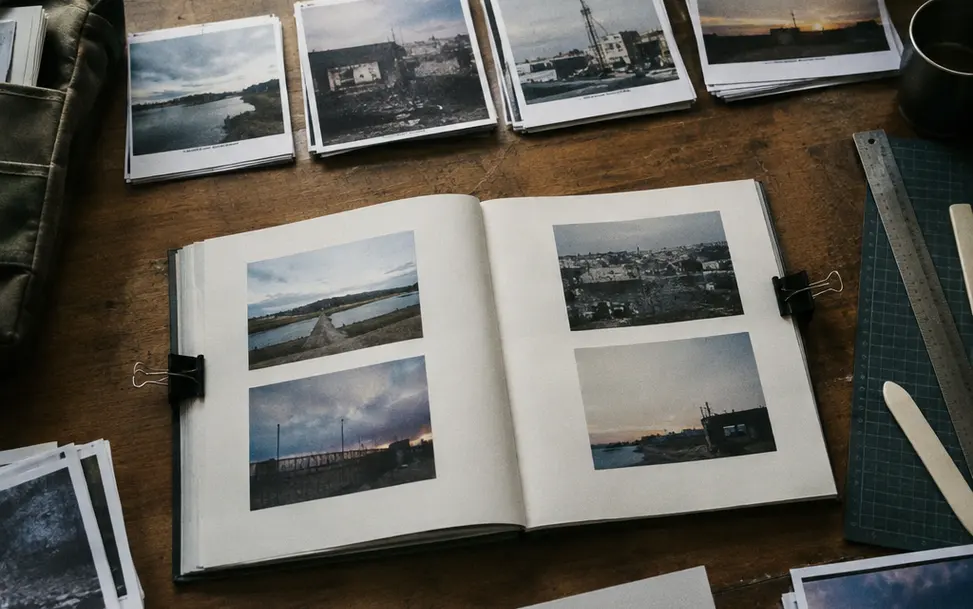
Across six intensive weekend workshops, the team constructed seven physical tape-bound dummy books. Working on paper rather than digital screens exposed rhythmic flaws immediately. The editors ultimately discarded a literal chronological layout, cutting several award-winning single frames that visually overpowered adjacent, quieter portraits. Every spread had to serve the broader historical cadence of the essay rather than showcase individual technical bravura.
Physical material specifications were selected to reinforce that narrative pacing and guarantee archival longevity:
- Photographic Plates: 192 pages printed on 150gsm matte-coated Japanese art stock, selected to hold deep shadow density without introducing distracting specular glare under gallery lighting.
- Text and Archival Insert: An 18-page insert printed on 110gsm uncoated cream stock housing the extended historical essays and verified field notes, providing a tactile shift between visual reportage and written scholarship.
- Structural Binding: Smyth-sewn binding assembled in 16-page signatures and wrapped in raw slate linen with a blind-debossed spine. This traditional thread-sewn construction allowed double-page spreads to lay completely flat, eliminating gutter loss across panoramic conflict frames.
Standing on the Press Floor: Proofing and Production Realities
Relying exclusively on calibrated studio monitors and digital soft-proofs invites disaster when translating low-light conflict reportage to offset lithography. When the first batch of physical wet proofs arrived from the press in late 2022, evaluating them under standardized D50 (5000K) daylight viewing booths exposed two severe technical failures. First, the deepest shadow values in the night-patrol sequences suffered from severe plugging, turning vital environmental textures into flat black ink. Second, a muddy magenta cast contaminated the mid-tones across mixed-lighting interior spreads.
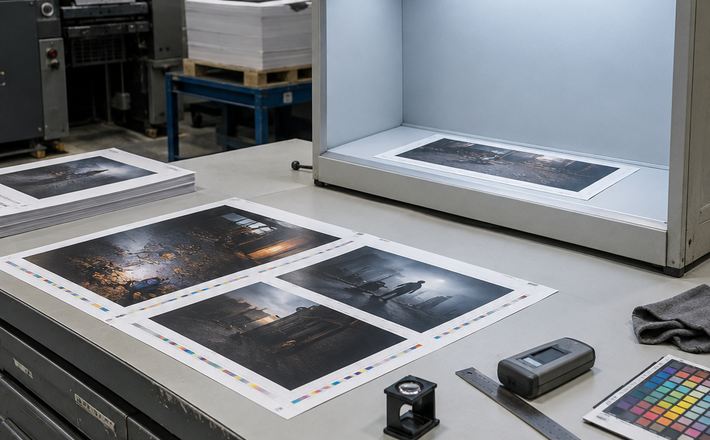
Correcting these flaws required physical intervention on the factory floor. One member of the collective flew out to stand beside the machinery for a continuous 36-hour sheet-fed offset run, monitoring 12-sheet signatures on a six-color press. Working side by side with the master pressman, the photographer executed real-time ink key adjustments as the paper ran through the rollers.
To prevent moiré patterns from forming inside fine fabric textures and woven basketry, the pre-press team utilized a 200-line-per-inch (LPI) stochastic screen. On the press floor, the crucial intervention involved pulling back black ink density in the 85%-to-95% shadow values to stop the night-patrol frames from plugging on the matte stock. Simultaneously, total ink coverage (TIC) was manually restricted to 280% across the darkest sequences to prevent wet ink from setting off onto opposing pages as the stacked signatures cured.
From Freight Pallets to Collector Bookshelves: The Fulfillment Bottleneck
Independent publishing romanticism evaporates the moment three shrink-wrapped wooden pallets totaling 1.6 metric tons are unloaded by sea freight onto a Melbourne studio street curb. Operating without a commercial distributor's warehouse infrastructure meant the collective had to manhandle, store, and dispatch 750 heavy hardcovers directly from their workspace.
The financial mechanics of international postage quickly emerged as the most volatile variable in the entire budget. At an individual book weight of 1.45 kg, the monograph sat dangerously close to international postal tier limits. Once wrapped in a double-walled cruciform mailer, each package crossed the 1.5 kg international airmail threshold, instantly eroding standard pre-order margins. Sending a single tracked parcel in that 1.5 kg to 2.0 kg bracket to Western Europe or the United States cost between $44 and $58 AUD.
| Production Phase | Specification / Operational Scope | Timeline | Cost Share / Allocation |
|---|---|---|---|
| Pre-Press & Dummy Testing | 7 physical tape-bound dummies, stochastic color separation, and two rounds of D50 wet proofs | 14 Weeks | Pre-Order Capital Baseline |
| Offset Lithography & Binding | 750 copies; 192pp (150gsm matte art) + 18pp (110gsm uncoated); Smyth-sewn raw slate linen | 36-Hour Press Run | $68 AUD / Unit ($42,000 AUD Pool) |
| Direct Collector Fulfillment | 1.6 metric tons (3 pallets); custom B-flute cruciform mailers with 30mm crumple zones | 11 Consecutive Days | $44–$58 AUD / International Parcel |
| Institutional & Trade Consignment | 120 copies placed with specialist bookshops; archival acquisitions at 4 university libraries | 16 Months to Sell-Out | 40% Retail Discount + Freight |
Cutting corners on packaging to slip back under the 1.5 kg postal threshold was never an option. Standard padded bubble envelopes guarantee crushed spine corners when heavy art books endure long-haul air transit. The collective commissioned custom die-cut, double-walled B-flute cruciform cardboard mailers engineered with internal 30mm crumple zones. Four photographers then spent 11 consecutive days hand-packing, weighing, and lodging customs declarations.
Beyond direct collector pre-orders, 120 copies were placed on consignment with independent photobook specialists and museum bookshops globally. Because these venues require a standard 40% retail discount plus outbound freight, retail consignment yielded a near-zero net financial margin. However, that targeted bookshop presence secured permanent archival acquisitions at four university libraries and fulfilled statutory obligations under the National Library of Australia legal deposit guidelines, cementing the work inside the public historical record.
Why You Should Print Half as Many Copies as Your Ego Demands
During post-project financial reconciliation, the collective audited their 750-copy print run against the commercial printer's highly seductive secondary quote for 1,500 copies. Doubling the print order had promised an immediate 34% drop in the per-unit manufacturing cost. On a spreadsheet, that unit-cost reduction looks like effortless profit; in practice, it is a trap that bankrupts independent documentarians.
Tracking the actual sales velocity of the 750-copy edition proved why discipline matters. After fulfilling the initial crowdfunding ledger and placing the 120 consignment copies, clearing the final 90 books from the studio shelves required 14 months of relentless institutional outreach, lectures, and direct curator pitches. The edition achieved complete sell-out status 16 months after publication without ever resorting to remaindered discounting. Had the collective yielded to vanity and printed 1,500 copies, not far from $16,000 AUD in hard capital would have remained frozen in unsold cardboard boxes, turning a working journalism studio into a dead-storage warehouse.
First-time independent documentary publishers must reject the illusion of economies of scale and cap their print run strictly to verified audience demand. A tightly edited, sold-out first edition of 500 to 750 copies commands immediate respect from gallery curators, protects the archival value of the collector tiers, and frees the photographer to return to the field rather than babysitting deteriorating inventory.
Do not open a spreadsheet or request a single lithography quote from a printer this week. Instead, print 60 to 80 working frames on a standard office laser printer, bind the pages together at home with artist tape, and put that physical dummy into the hands of three ruthless photo editors over a 10-day review period. Until the sequence survives that paper crucible without a word of verbal explanation from you, the book is not ready for the press.