When the Rupiah Freefalls, Where Do You Point the Lens?
How do you make an invisible macroeconomic collapse visible in a single frame without exploiting the people crushed by it? That question governed every darkroom edit during a six-week deployment in Jakarta running from late April to early June 1998. Across the capital, the Indonesian rupiah plunged from roughly 2,500 per US dollar before the crisis to between 11,000 and 16,500 per US dollar during street exchanges in May and June 1998. What international economists tracked as a sovereign liquidity failure registered at street level as an immediate evaporation of household caloric intake, medicine access, and social standing. For visual anthropologists and documentary photographers on the ground, the assignment demanded an immediate methodological rupture from conventional spot-news habits.
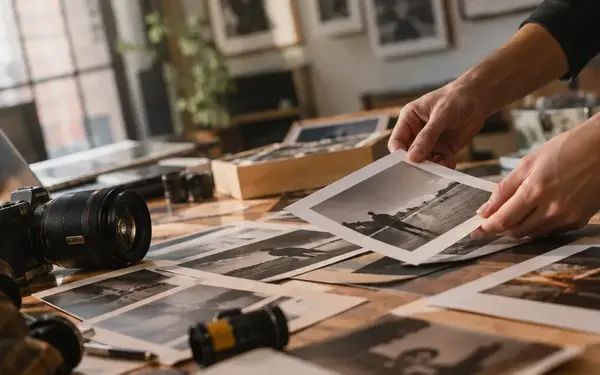
During the first 72 hours of the deployment, the collective laid out initial contact sheets on the tiled floor of a rented Menteng guesthouse. The flaw in the work was immediately obvious. Chasing sirens in shared taxis produced identical wire-style riot frames while missing the structural collapse entirely. Overseas picture desks demanded dramatic riot imagery, burning tires, and shattered bank facades—treating the crisis as a sequence of kinetic binary options between state order and street anarchy. Meanwhile, the quiet starvation of the middle and working classes unfolded in plain sight behind closed metal shop shutters.
To document both realities without surrendering to spectacle, the team dismantled its workflow. Four-hour morning editorial debates were scrapped in favor of 20-minute dawn dispatches before street temperatures and tear gas concentrations rose by 10:00 AM. The roster split into two specialized units: two photographers monitored student barricades near the parliament complex, while the remaining photographers embedded within residential neighborhoods to trace the domestic geometry of hyperinflation.
Analogue Workflow and Cash Logistics Under Hyperinflation
Tap water in the makeshift second-floor bathroom darkroom of the Menteng guesthouse hovered between 28°C and 31°C. At 31°C, warm tropical water softens silver gelatin emulsion to the point of reticulation, threatening to slide the image right off the cellulose base. Before the midnight curfew locked down the district, photographers bought blocks of street-vendor ice to pack around stainless steel tanks, bringing developer baths down to a workable 20°C to 22°C range. Every physical step of the analogue pipeline fought the environment and the collapsing infrastructure.
Once negatives dried in the humid bathroom stall, digital delivery presented a second bottleneck. Uncompressed dial-up drum-scan transmissions took 18 to 26 minutes per single 2-megabyte JPEG frame over noisy copper phone lines before line drops forced a restart. Field rationing capped each photographer at 4 rolls of 36-exposure 400-ISO black-and-white film for daily domestic documentation and 2 rolls of color negative film for spot news. That strict physical ceiling forced an observational discipline before the camera ever reached the eye.
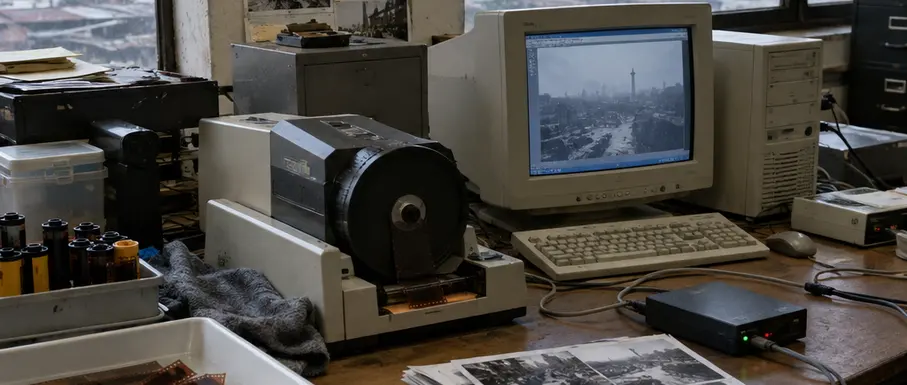
Standard foreign-correspondent habits failed by the second week of May. Relying on hotel drivers, carrying large local denominations, and working from official briefings proved useless when local ATMs froze and street moneychangers began rejecting scarred or creased US twenty-dollar bills. The macro-level mechanics recorded in the IMF history of the 1997–98 Asian Financial Crisis in Indonesia manifested on the pavement as hour-by-hour repricing of basic survival goods. Photographers abandoned hotel base camps, carried pristine small-denomination foreign currency sewn into webbing belts, and walked kilometer-long transects through urban quarters to conserve fuel and maintain proximity to neighborhood supply chains.
Pushing Back Against Wire-Service Appetites for Spectacle
Subsidized bulk rice prices climbed from roughly 1,000 rupiah per kilogram to between 2,800 and 3,500 rupiah per kilogram inside five weeks. Cooking oil and kerosene queues regularly stretched 300 to 500 meters, with residents waiting 3 to 5 hours starting before 05:30 AM. Evening edits over crackling telephone lines became sites of daily tension: overseas desks pressed for visceral scuffles at state logistics depots, while the collective insisted on documenting the quiet dignity of families liquidating household goods to buy cooking fuel.
Two Approaches at the State Logistics Queue
At neighborhood distribution points, a photographer faces a stark spatial choice. The standard wire-service approach positions the camera on the elevated bed of a delivery truck fitted with a 20mm wide-angle lens. Looking down into a crowd of hundreds of people reaching for ration tickets, the wide lens distorts facial proportions, compresses human beings into a frantic, anonymous mob, and manufactures visual panic even when the line is orderly. Such framing privileges the geometry of scarcity over the agency of the citizen.
The collective banned elevated wide-angle shooting at food lines and instituted a strict two-frame rule paired with eye-level environmental portraiture. Photographers stepped out of the press pack, walked to the tail end of the 500-meter queue, and waited 30 to 45 minutes alongside residents before raising a camera. Working at eye level with a normal focal length preserves sovereign individual posture; the frame captures the pressed collar of an unemployed clerk holding an empty plastic jerrycan, situating the economic trauma within a recognizable human biography.
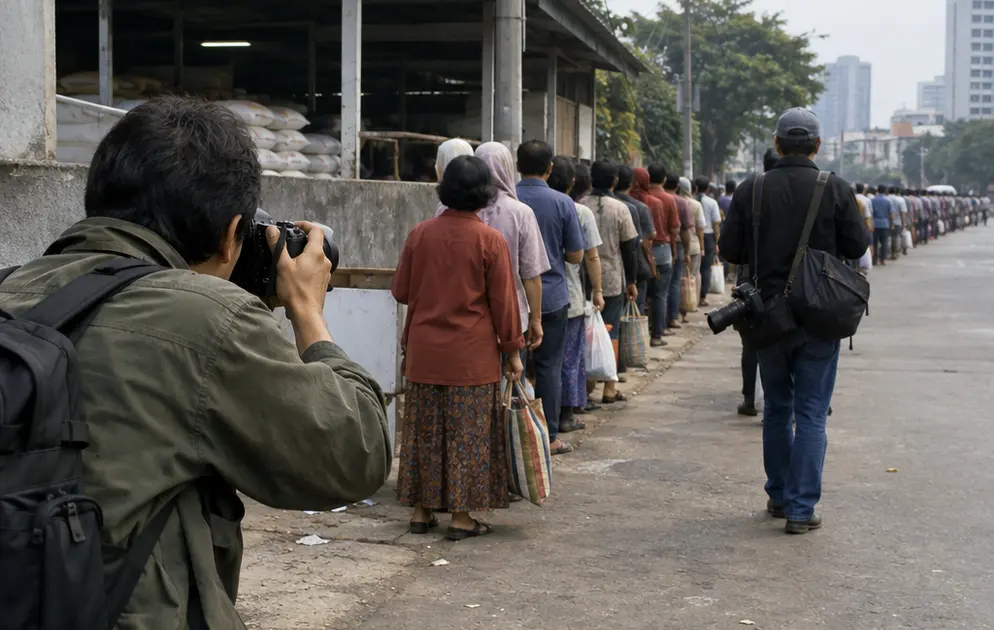
Because a six-week deployment captures only the acute shock phase of a currency collapse rather than multi-year household recovery, photographers must anchor every domestic frame with granular ledger details—recording pre-crisis wages alongside current street prices for rice and fuel in the caption—so future historians can distinguish sudden impoverishment from chronic poverty. To enforce this archival standard, the team instituted mandatory notebook logging of three baseline metrics on every roll:
- Neighborhood classification: The specific administrative sub-district and urban village where the queue or domestic transaction took place.
- Exact timestamp: The calendar date and morning hour, accounting for intraday price volatility across street markets.
- Commodity baseline: That morning's street price for one kilogram of medium-grade rice and one liter of kerosene in local currency.
Field Protocols for Photographing Sudden Poverty Without Exploitation
Documenting sudden status loss carries acute ethical hazards. Across Jakarta, newly unemployed bank clerks, civil servants, and small factory owners stood on sidewalks selling wristwatches, porcelain dinnerware, and children's bicycles. Unlike subjects accustomed to public market life, individuals experiencing abrupt downward mobility feel profound humiliation under media scrutiny. Treating their private liquidation as public street theater violates their visual sovereignty.
To prevent predatory framing in cramped residential alleys, the collective enforced a strict hardware and behavioral protocol:
- Focal length restrictions: Residential kampung work was restricted exclusively to 35mm and 50mm prime lenses at a working distance of 1.2 to 2.5 meters. Long telephoto lenses were banned in residential sectors because compressing space from across a street turns observation into surveillance.
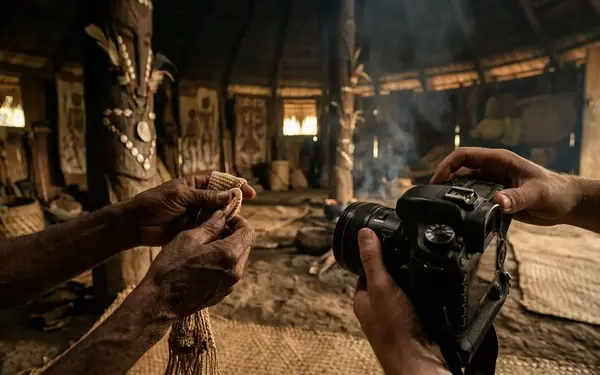
- Community mediation and unphotographed time: Photographers carried bodies hanging at waist level and approached households through local neighborhood heads (RT/RW). Once inside a domestic interior, the team observed a mandatory 15-to-30-minute unphotographed sit-down protocol—drinking tea, listening to family employment histories, and explaining how the negatives would be archived—before exposing a single frame.
- Evidentiary protection during unrest: Whenever documenting looting suspects at burned commercial centers or unmasked student organizers within 100 meters of military checkpoints, photographers were required to use complete silhouette or rear-three-quarter framing.
Visual Sovereignty Protocol
When state security forces actively harvest published press imagery to identify demonstrators or desperate citizens taking food from shattered depots, an identifiable front-lit portrait ceases to be journalism and becomes a police dossier. Lowering the camera, or shifting ninety degrees into deep shadow to render the subject anonymous, is the sound operational choice in conflict and crisis zones.
What a Scratched Negative Strip Still Teaches About Financial Ruin
Decades after the curfew lifted, the collective conducted an archival review across more than 140 hand-annotated contact sheets preserved from the 42-day Jakarta deployment, comparing those cellulose acetate strips against digital files produced during regional economic crises between 2020 and 2024. That comparative audit now anchors the permanent training curriculum for field documentarians covering socio-economic upheaval across the Asia-Pacific.
The physical scarcity of the 1998 Menteng darkroom enforced a cognitive stillness that modern sensor technology actively erodes. A typical two-hour domestic visit in 1998 yielded 6 to 12 exposed frames on a single 36-exposure strip, compared to 300 to 500 raw files in modern digital workflows. Reviewing sequences where a photographer spent only four carefully timed frames on a family closing their multigenerational textile stall shows how mechanical restraint alters ethical posture. When you cannot bracket your empathy across five hundred burst frames, you must wait until the human gesture and the environmental context align in the viewfinder.
That discipline was ultimately governed by a ruthless economic equation on the pavement outside the darkroom. By mid-1998, an imported 36-exposure roll of professional 35mm film cost between 45,000 and 60,000 rupiah in Jakarta camera shops, while a day laborer's daily wage sat between 6,000 and 10,000 rupiah—meaning the physical silver halide emulsion inside a single canister of film cost five to six days of local manual labor, turning every press of the shutter release into an uncompromising accounting of human value.