Contents
- How Bougainville Was Sealed Off From the Press
- The Night Crossing From Choiseul
- Ninety-Six Hours of Sealed Bags at Guava
- How One Crossing Rewrote the Collective's Deployment Rules
- Rice, Socks and Ammunition Tins: Getting 65 Rolls Out
- Build the Trust Network First, or Stay on the Beach
How Bougainville Was Sealed Off From the Press
How does an independent photographer document a total military blockade when every official channel is closed and nobody will come to get you if it goes wrong?
That question shaped Ben Bohane's approach to Bougainville in the mid-1990s. From 1990 to 1997, a naval and air blockade encircled the island. The Bougainville Revolutionary Army (BRA) held the mountainous interior, and Papua New Guinea's security forces controlled the sea lanes and the airstrips. The result was one of the most complete media blackouts in the modern Pacific. For nearly 44 consecutive months, not a single international wire reporter was permitted inside the central Panguna crater region, the site of the copper mine at the root of the conflict.
Bohane tried the front door first. Over a nearly eight-month window in 1994, Port Moresby defence officials turned down six consecutive press visa requests. The few journalists who did secure sanctioned military embeds learned what that access was worth. They were held to tarmac briefings in Buka, on the island's northern tip, and never reached the Crown Prince Range where the war was being lived.
The standard newsroom assignment protocol could not solve this problem. It depends on accreditation, a fixer arranged by the bureau, and an exit plan underwritten by the employer. On Bougainville, the accrediting authority was a party to the conflict, the bureau had no presence, and any exit plan ran through the same military that was enforcing the blockade.
So Bohane dropped the press-pool route altogether. The alternative was an underground entry by sea from the Solomon Islands, without credentials, sponsors or the protection that comes with either. The protocol that emerged from that decision is reconstructed here as a working method for photographers and editors facing similar closed territories.
The Night Crossing From Choiseul
The boat was a 19-foot open fibreglass banana boat with a single 40-horsepower outboard. The water to cross was roughly 45 nautical miles of the Solomon Sea, a run that took between three and a half and five hours depending on swell. Pacific-class patrol boats watched the Bougainville Strait.
Those constraints shaped the crossing.
Timing against the radar
Daytime departures were out. Bohane and his Solomon Islander boatmen launched from Choiseul province at 2:00 AM, timed to a moonless night and a low-pressure squall. The rain and sea clutter masked the radar signature of a small fibreglass hull. On any crossing like this, the choices narrow to binary options: go tonight, under the weather that hides you, or wait and lose the window. The crew chose the squall.
Fuel took priority over passengers. A 400-litre load filled two-thirds of the deck, and that space was non-negotiable because it guaranteed the Choiseul crew could get home. A boat that runs dry on the return leg leaves its crew drifting in a patrolled strait with no cover story, and the photographer who chartered the trip carries that risk.
Kit weight against footprint
A commercial broadcast crew in the 1990s moved with cases of batteries, chargers, a satellite phone, and often a generator. None of that fits in a banana boat, and all of it fails in a cloud forest. Bohane's entire working kit went into a nearly 11-kilogram dry bag:
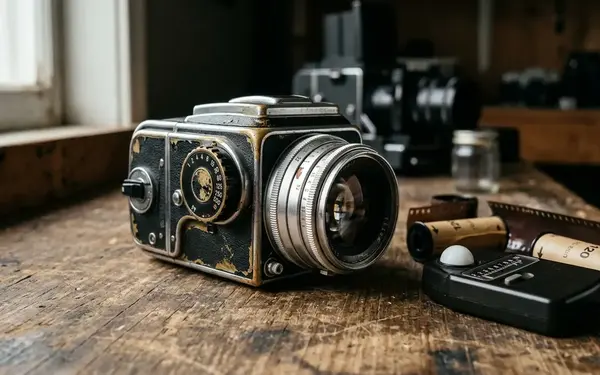
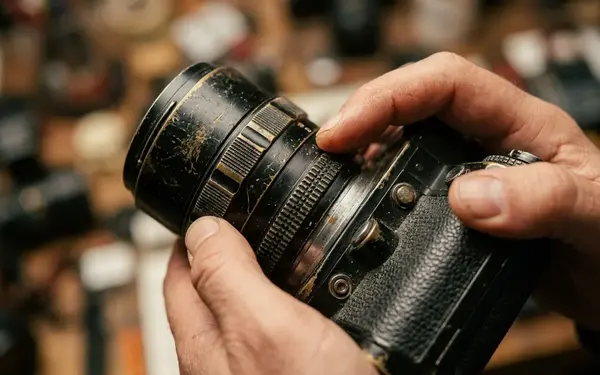
- Two purely mechanical 35mm bodies, one rangefinder and one SLR
- Three prime lenses: 28mm, 35mm and 50mm
- Film stock, sealed against water and humidity
- Handwritten paper notebooks for captions and names
The mechanical bodies decided the rest of the trip. Battery-dependent shutters and electronic light meters tend to fail within about ten days in cloud-forest humidity near 95 percent. A brass-geared mechanical camera keeps firing as long as the photographer can wind it. On a three-week walk with no power source, that difference determines whether the assignment produces anything at all.
Why the satellite phone stayed behind
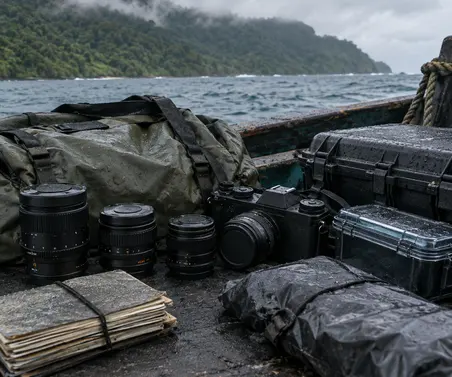
The most important choice was what Bohane left out. He carried no battery-powered communication gear, no satellite transceiver and no emergency locator beacon.
This can look reckless from an editor's desk. Inside the blockade zone, it was the safest option available. The interior valleys were effectively zero-transmission environments. A single outbound signal ping from a place where nothing else transmits marks the source for anyone listening, and the source would have been a host village. A transmission could bring mortar fire or helicopter strafing down on the people sheltering the photographer. Diplomatic cover worked the same way in reverse: any embassy aware of the trip becomes a channel through which the boatmen and couriers could be identified later.
Leave the Beacon Ashore
If your safety plan relies on a device that transmits from inside a closed territory, look at who receives that signal besides your editor. When the answer includes the military enforcing the blockade, the device protects you at the cost of the village hosting you.
Ninety-Six Hours of Sealed Bags at Guava
Bohane's camera bags stayed closed for the first 96 hours after he reached the mountain base near Guava village.
For four days, village elders and BRA commanders debated who he was. To an isolated insurgency under blockade, every outsider was a possible intelligence asset. A foreigner arriving by boat from the Solomons could be a journalist, a spy, or a journalist whose film would end up in the hands of spies. Bohane did not press for combat patrols or ask to photograph fighters during the vetting. He sat through the kastom reconciliation process, the customary protocol through which Melanesian communities establish whether a stranger can be received.
The outcome was a visual protocol, agreed in advance and kept for the length of the stay. It set out what could be photographed and what could not.
Open to the camera: cultural practices, daily survival under blockade, the improvised medicine and food production of a cut-off population, and combatant life inside the strongholds.
Closed to the camera: coastal landing beaches, the facial features of radio operators, directional landmarks that could orient an attacker, and every coastal supply drop point. Couriers moving between the island and the Solomon Islands could not be photographed at all. Not one frame of their faces was made.
These limits shaped what the archive contains. The resulting body of work holds almost nothing about how the resistance was supplied, because recording it would have exposed the people supplying it. That gap was the price of access, and Bohane accepted it before he exposed his first roll.
Working to kastom time
The pace of the work followed the community's schedule. After vetting came a walking circuit of at least three weeks through steep jungle tracks, from the central mountains down to the southern strongholds. Movement depended on when escorts were available, when it was safe to cross a ridge, and when a community was ready to receive a visitor. News-cycle deadlines had no influence on any of it.
Photographers trained on wire assignments find this rhythm difficult. Days go by without a usable frame, and then a ceremony or a funeral or a quiet afternoon in a stronghold produces the pictures that define the story. Shooting to a deadline in Melanesia means photographing whatever is placed in front of you on day two, which is usually the version of events the hosts have prepared for outsiders.
The protocol has one clear limit, and it affects anyone planning a similar entry. Unwritten kastom guest protections hold only where village elders' authority is recognized. In fragmented conflicts, where splinter factions or external mercenary forces answer to no customary leadership, the safeguard that protected Bohane at Guava may not exist. Before relying on it, find out whether the armed actors in your target area recognize the elders who will vouch for you.
How One Crossing Rewrote the Collective's Deployment Rules
The deadlines were the real problem. After the Bougainville dispatches, the Degreesouth collective reviewed its own record and found the same pattern again and again. Wire-service schedules had pulled photographers out of Melanesian conflict zones at the point when deep cultural access was finally being granted. Editors wanted 48-hour turnarounds, and access in these communities typically took weeks to earn.
The fix was financial before it was operational. Members pooled self-syndication revenue so that no single editor's deadline could end a deployment. That pooled money bought time, and time changed the rest of the model.
The table below sets the two approaches side by side.
| Operational Variable | Standard Commercial Newsroom Model | Degreesouth Unembedded Protocol |
|---|---|---|
| Entry & Access Channel | Official defence ministry accreditation; military embeds limited to briefings such as the Buka tarmac | Community-negotiated entry via kinship and diaspora networks, with kastom vetting on arrival |
| Time in the Field | 4-to-7-day commercial assignment windows; editorial turnarounds of nearly 48 hours | 28-to-45-day self-funded immersions across Melanesia and eastern Indonesia |
| Preparation | Bureau-arranged fixer, booked days before arrival | 3-to-6-month lead time cultivating contacts in port towns such as Honiara, Vanimo and Darwin |
| Local Partners | Fixers hired as service providers | Fixers, boatmen and couriers treated as equals whose safety outranks the story |
| Camera Systems | Battery-dependent electronic bodies | Mechanical shutter backup required on every humid-jungle deployment |
| Communications | Satellite phones and locator beacons for employer safety | Offline by default inside zero-transmission zones; analogue notebooks for records |
| Exit Plan | Employer- or embassy-backed evacuation | Total personal liability; no consular evacuation outside recognized customs ports |
Three changes that stuck
- Longer windows. Assignments went from four-to-seven-day commercial stints to self-funded field immersions of 28 to 45 days. That is long enough to sit through a vetting period, walk a circuit, and still have weeks left once the hosts trust you.
- Mechanical redundancy as a rule. Every deployment into humid jungle now has to carry a mechanical shutter backup, without exception. On Bougainville this came down to one photographer's judgement. Afterwards the collective made it a requirement.
- Networks before assignments. Members now spend three to six months before deployment building relationships with diaspora communities and kinship contacts in the port towns that serve as gateways. Honiara, Vanimo and Darwin became the places where coverage actually begins, often long before any travel.
The collective applied this structure to later independent coverage across the Asia-Pacific, in places where the formal press apparatus was either absent or controlled by one side. The underlying logic carried over: access comes from people, those people need protecting, and protecting them takes time that commercial schedules do not allow.
Rice, Socks and Ammunition Tins: Getting 65 Rolls Out
Relative humidity at close to 1,200 metres in the Crown Prince Range sat between 85 and 98 percent. In that air, unprotected film begins to deteriorate within days.
By the second week in the cloud forest, Bohane found fungal blooms forming inside his lens elements and emulsion swelling on unsealed rolls. He had no climate control, no commercial silica supply and no way to resupply. He improvised a desiccation routine from what the villages had:
- Each evening, roast raw white rice in a tin pan over a wood fire until it is fully dried.
- Cool the rice inside cotton socks, which become breathable desiccant packets.
- Seal the packets alongside exposed 35mm canisters inside double-walled ammunition tins.
- Repeat nightly, because the rice saturates and has to be dried again.
It was laborious, smoky work done after long days on the trail, and it kept the emulsion usable. Without the routine, the photographs from the interior would most likely have been lost.
Humidity Discipline Daily
Treat desiccation as a daily chore, like cleaning a rifle. Exposed film that spends one night unsealed in a cloud forest can take damage you will only find in the lab weeks later.
Splitting the record
The exit raised a custody problem. Bohane had 65 rolls of 35mm black-and-white and colour reversal film, the whole visual record of a war that the outside world had barely seen. Sending it in one load across a patrolled strait meant a single interception would wipe out everything.
So the rolls went out in three separate courier batches. Splitting the archive had a second purpose as well. A small parcel is easier to hide and easier to throw overboard, so no single boat crew carried enough material to be worth a patrol's interest or to justify a crew risking their lives over it. The crews' safety ranked above the film, and the batching reflected that order.
Film took 14 to 21 days to travel from exposure in the mountains to chemical processing in Australian labs. For those weeks, nobody, including the photographer, knew whether the pictures existed. The rice and ammunition tins were all that protected them.
What the negatives mean now
Those physical negatives became part of the documentary record of a conflict that the official press system largely missed. With wire reporters kept out of Panguna for somewhere around 44 consecutive months, historians and curators looking at the blockade years have very little independent visual material from inside the interior. The war eventually moved toward a political settlement, set down in the Bougainville Peace Agreement, and the images made under the blockade show the daily life of a population that was cut off from the outside world.
The negatives show what the protocol at Guava allowed: gardens, ceremonies, fighters at rest, children growing up under siege. The beaches and the couriers are absent, as agreed, and those absences are a deliberate part of the archive.
Build the Trust Network First, or Stay on the Beach
Editors and collective members who reviewed three decades of regional coverage reached a consistent conclusion. The records that lasted came from assignments where the journalist accepted total personal liability and refused to carry satellite beacons that could compromise host villages. Rapid-response media drops rarely produced anything comparable.
The recommendation follows from that. Photographers and the editors who commission them should stop treating closed conflict zones as parachute assignments. A four-day window and an embassy phone number will get you the Buka tarmac at most.
The commitment is specific. Before you ask anyone to move you across a border outside official channels, spend six to twelve months building relationships with the regional gatekeepers who can vouch for you. Learn the kastom of the communities you plan to enter. Get to know the diaspora families in the port towns. Find out which boatmen have relatives on the far shore and what a failed crossing would cost them. Choose your kit for the climate and for silence, which means mechanical bodies, paper notebooks and nothing that transmits.
Then be honest about one fact. Once you cross outside recognized customs ports in the Solomon Sea, no consular evacuation exists. No embassy will come for you, and none can protect the village that takes you in.
The Guava Standard
Sealed bags for four days, an agreed list of forbidden frames, and a fuel load sized for the crew's return before anyone else's comfort.
That is the standard the Bougainville assignment set, and it still applies in full: if you cannot protect the community hosting you without an embassy's help, do not make the crossing. Put the months into the network, and go only when the people on the far shore are ready to receive you.